The symbol “≅” is the congruent symbol, used to indicate that two mathematical objects are congruent. Congruent means that the objects match in shape and size; this is a stronger condition than rough similarity or approximate equality (which is usually denoted by the tilde operator). In geometry, for example, the symbol indicates that figures are identical in both shape and size.
Congruence in Geometry
In geometry, we can use the notation of angles to show congruence. The angle formed at point A can be written ∠A when the intended rays are clear; angle BAC names the same vertex specifically through rays AB and AC. When using angles, the order of the points is important. In addition, matching arcs are drawn inside congruent angles to denote the relationship, with different numbers of arcs used to distinguish separate pairs. Likewise, the notation for segments shows congruence with tick marks. Two angles are congruent when they have the same measure, so ∠A ≅ ∠D is written rather than saying the angles themselves are equal with =. Segments with the same length are congruent segments: AB = CD implies AB ≅ CD.
When it comes to congruence, you may have heard the term applied to triangles and polygons. You’ve also likely heard the term applied to modular arithmetic, where congruence is used to describe numbers that share the same remainder after division. The meaning is clearly different between these two applications of congruence, and hence the standard notation changes depending upon the mathematical context. The symbol is sometimes called “isomorphic,” though the identity of congruence should be clear from the context.
Unicode and Symbol Codes
Unicode has assigned U+2245 to the glyph “≅,” formally calling it APPROXIMATELY EQUAL TO. While the glyph appears in Unicode’s Mathematical Operators block, the entity name doesn’t suggest congruence. This mismatch seems to be the result of Unicode having adopted the glyph for isomorphism instead of congruence when assigning names.
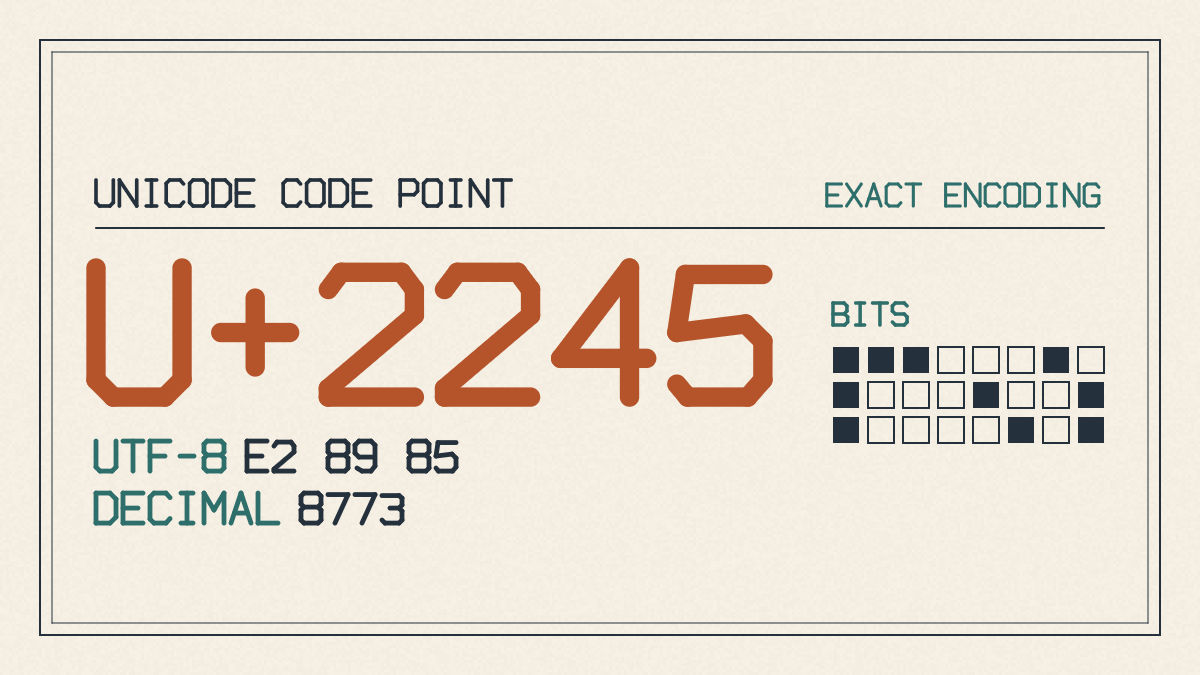
You’ll find the congruent symbol represented in various formats:
-
Hexadecimal code:
≅ -
Decimal code:
≅ -
Named HTML entity:
≅ -
Named HTML entity:
≅
This guide provides a reference for the symbol in HTML and LaTeX.
The congruent symbol, or ≅, denotes that two mathematical expressions are congruent. When it comes to geometry, congruence means that the corresponding parts of two geometric figures are equal in length and measure. In other words, the shapes match exactly, and one can be transformed into another through rigid motions such as translations, rotations, or reflections without altering their shape or size. Polygon congruence statements must list corresponding vertices in the same order; for example, △ABC ≅ △DEF means AB ≅ DE, BC ≅ EF, AC ≅ DF and ∠A ≅ ∠D, ∠B ≅ ∠E, ∠C ≅ ∠F.
The language of congruence is also used in modular arithmetic, where two integers are said to be congruent if they share the same remainder when divided by a given modulus. In this case, the symbol ≡ is typically used to denote congruence modulo N.
In Unicode, the symbol ≅ is encoded as U+2245, which is referred to as “APPROXIMATELY EQUAL TO.” However, the name does not reflect the intended meaning of congruence, leading to some confusion in certain contexts.
To represent the symbol in a document, you can use the hexadecimal code 2245 or the decimal code 8773. Alternatively, you can use named HTML entities, such as ≅ or ≅. When coding in LaTeX, you can use the command \cong to typeset the symbol in math mode.
Because the Unicode name refers to approximate equality, it is important to recognize that this symbol is not interchangeable with the “approximately equal to” symbol (≈) in mathematical usage. The meaning of the symbol depends on the context, so it is crucial to understand how it is being used before applying it to your work.
As you can see, the congruent symbol is a powerful tool in mathematics, allowing us to express complex ideas in a simple and concise manner. Whether you are working in geometry, algebra, or modular arithmetic, the symbol provides a way to communicate the relationships between different mathematical objects.
Whether you are a student or a professional, it is important to understand the proper usage of symbols like the congruent symbol. By taking the time to learn how to correctly apply these symbols, you can ensure that your work is accurate and effective. With a little practice, you will become comfortable using these symbols and will be able to apply them confidently in your own work.