The greater than sign has a specific meaning in mathematics. The “>” symbol is used to compare two numbers, where the number that’s larger appears on the left of the comparison operator. For example, “8 > 3,” which is read as “eight is greater than three.” It’s also possible to have decimal or negative numbers, such as “1.5 > 1” or “1 > −2.”
Orientation Rule
The basic orientation rule for distinguishing between “>” and “<” is based upon the open side. If you imagine a small mouth with teeth, it always opens toward the larger number. You can remember this by remembering that the open side points toward the larger number (or just remember that “BIG > small”). Likewise, the pointed tip always faces the smaller number.
In programming and markup, the greater than sign is used in various ways, including comparisons and escaping characters.
Similar Symbols
It’s important not to confuse the greater than sign (“>”) with symbols that look like it, including the greater than or equal to sign (“≥”), the much greater than sign (“≫”), the right-pointing angle bracket (“〉”), and other similar characters.
You can use the greater than sign in many ways. You can enter it directly on your keyboard, type it using its ASCII character code, or use special HTML or LaTeX input methods to insert it into documents.
Standard Greater Than Sign
On a standard US keyboard, you can press Shift+period to insert the greater than sign, but depending on what keyboard layout you are using, this might vary.
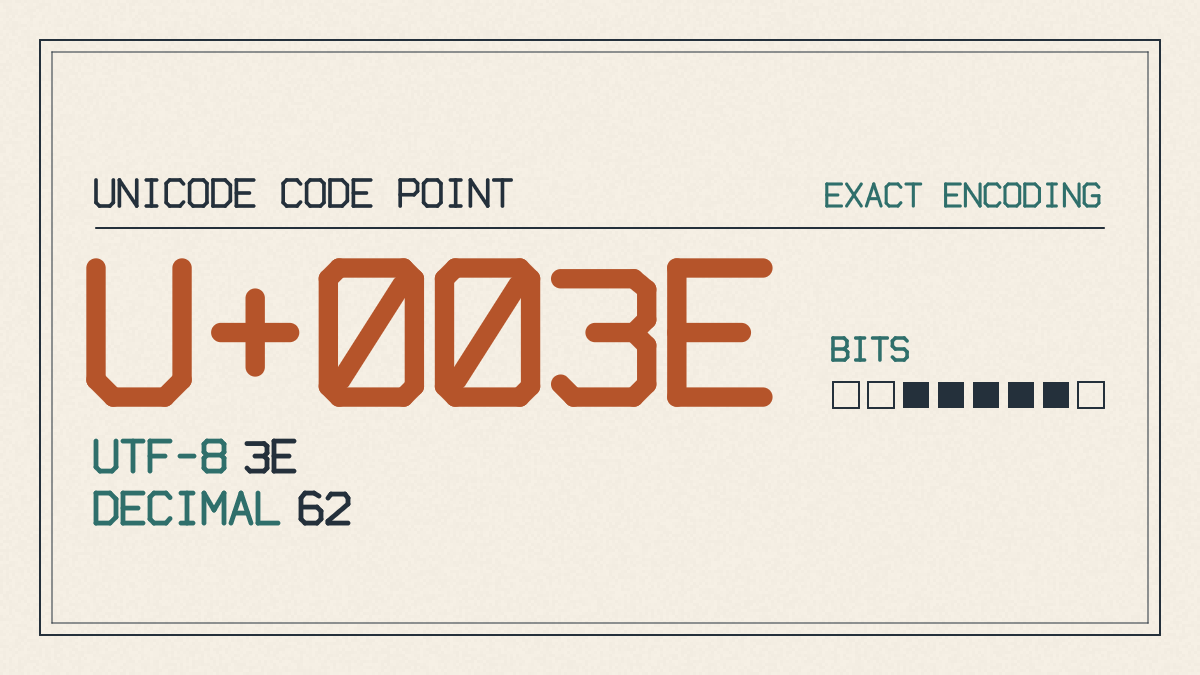
ASCII codes define all characters, from letters and numbers to special characters. The ASCII code for the greater than sign is 62 (in decimal) or 3E (in hexadecimal).
Unicode defines the greater than sign as U+003E. This is an extension of the ASCII character set, so you’ll see the same glyph on both modern computers and smartphones.
In most HTML documents, the greater than sign is entered either literally (using the symbol itself), or using its escape sequence: >. In XML, the same rules apply. In SGML (Standard Generalized Markup Language), the same > escape sequence may also be used.
There are also related Unicode symbols, including U+2265 for the greater than or equal to sign and U+226B for the much greater than sign. The standard greater than sign itself remains U+003E.
The greater than sign is also used in programs, where it may be used in expressions like 4 > 3 or 9 > 10. You can also use the greater than sign to end tags in markup, such as <head> in HTML.
In LaTeX, there are several different approaches to inserting the greater than sign. To use the greater than sign inside a math expression, you can simply use the “>” character. Outside math mode, it may not render as the usual text-based greater than sign. You can also use \textgreater within a document to produce a regular text-based greater than sign.
If you’re working in a markup language, like XML, you need to make sure that the greater than sign doesn’t appear literally within a tag. You should escape any instances of the symbol using >.
Finally, the greater than sign may also appear when writing a comparison expression in a program. When doing this, you’ll generally write it directly into your source code, such as comparing values against one another: if(x > y)
Other Characters That Look Like Greater Than
Because the greater than symbol looks like a variety of other signs, it’s worth being careful about which one you use.
The greater than or equal to sign is very similar, but it’s written as “≥”. In Unicode, it’s U+2265, whereas the simple “>” sign is still defined as U+003E.
Some languages, especially C++, include the much greater than sign as “≫”. In Unicode, it’s U+226B. ASCII does not include the much greater than sign, so “>>” is often used as an approximation in plain text. In Java, C, and C++, that double greater than sign also serves as the right-shift operator.
A variation of the greater than sign is the right-pointing angle bracket, written as “〉”, and defined in Unicode as U+300C. As its name suggests, it resembles a corner, rather than the straight lines of the “>” and “<” signs.
Finally, the greater than sign may also appear as part of a bracketed pair of characters, particularly in XML. These brackets are usually used to denote the start and end of a document section, and may be represented as “〈” and “〉”.